Key principles
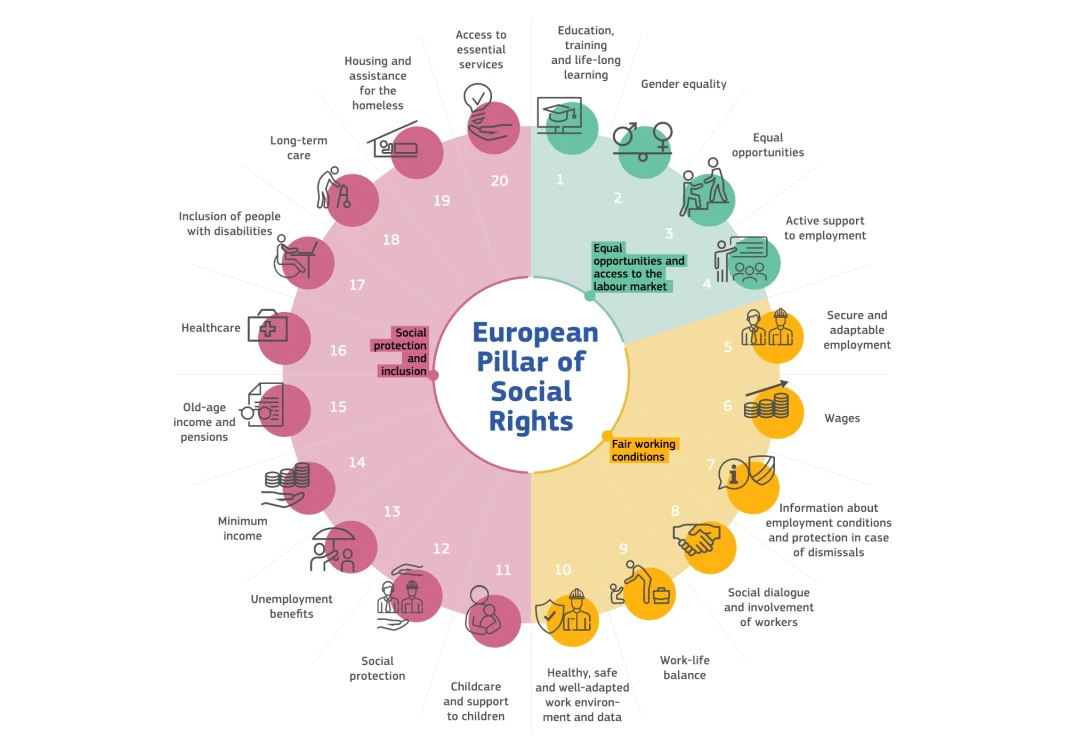
YES Forum believes that tackling poverty in Europe requires a holistic, long-term approach grounded in the real-life experiences of youth and social work professionals. By ensuring their insights inform policymaking at all levels, we help translate the four principles of Chapter 1 of the European Pillar of Social Rights into concrete actions that support young people and foster social cohesion:
Principle 1: Education, training and life-long learning
YES Forum and its member organisations are committed to breaking down the barriers that prevent disadvantaged youth from accessing quality education, training, and employment.
Through tailored upskilling and reskilling initiatives, we support young people, particularly those who are NEET, to develop the competencies and confidence needed for long-term integration into the labour market.
At the same time, we strengthen the capacity of youth and social care professionals, enabling them to better support disadvantaged young people and engage in meaningful policy advocacy at both national and EU levels.
Principle 2: Gender equality
We recognise that young women often face additional barriers to accessing opportunities. We have an organisational culture where different perspectives are valued, and where all staff and collaborators regardless of gender, ethnicity, age, disability, or socio-economic background feel respected, supported, and empowered to contribute. This commitment is reflected not only in our internal operations, but also in how we design our activities, select participants, and engage with our wider network.
We promote inclusive practices to our member organisations, and support young women to build confidence, develop competencies, and explore diverse career pathways through our project and mobility opportunities, contributing to a more balanced and inclusive labour market.
Principle 3: Equal opportunities
Our network actively embraces diversity as a societal strength. By including all young people regardless of their background, disabilities, or socioeconomic status in our programmes, we dismantle the barriers that lead to exclusion and pave the way for a more equitable society.
Moreover, by supporting disadvantaged young people on their educational and professional paths, we empower them to overcome systemic barriers and realise their full potential. Through our tailored programmes and targeted capacity-building initiatives, we provide essential skills, mentorship, and access to quality education and training opportunities. This approach not only enhances their personal and professional development but also fosters a more inclusive society, ensuring that every individual has the opportunity to contribute meaningfully.
Principle 4: Active support to employment
Our activities are designed to support and empower disadvantaged youth in their transition to adulthood. Through the assistance provided by our member organisations, we address a wide range of challenges ranging from financial, psychological, educational, social, and physical issues. Our innovative reskilling and upskilling initiatives tackle both youth unemployment and skills mismatches across the EU, facilitating smoother transitions into the labour market.
In addition, we actively promote European funding opportunities, particularly those focused on social funds, to further strengthen our capacity to support disadvantaged young people. With our work we also contribute to a reinforced Youth Guarantee that more effectively addresses regional differences across Europe and gaps, particularly in outreach to rural areas and those who need it most.
The European Commission published an easy-to-read explainer of the European Pillar of Social Rights on their website (Link).
New EPSR Action Plan
On 22 July 2026, the European Commission published its Communication on the European Pillar of Social Rights, renewing its commitment to social Europe as the Pillar approaches its tenth anniversary. Rather than replacing the 2021 Action Plan, the Communication complements it: the 20 principles remain, including the shared framework, and the three 2030 headline targets on employment, skills and poverty reduction. We were pleased to contribute to the Strategic Dialogue and the public consultation in 2025, and we see in the final text a genuine effort to listen to civil society and to those implementing the Pillar on the ground.
We are encouraged to see several themes from our consultation input reflected in the text, including
- the strengthened European Child Guarantee,
- the intergenerational fairness perspective,
- improved poverty indicators that better capture lived realities, and
- the explicit recognition of civil society as a central partner in delivery.
We value this continuity, and the Commission’s acknowledgment that real work lies ahead to achieve these goals. While the EU is on course to meet its employment target, adult participation in learning and poverty reduction remain short of where they need to be, with the reduction of only around 3.5 million people at risk of poverty or social exclusion since 2019, against a target of 15 million.
What has changed is the focus. The Communication identifies three new pressure points, these are:
- the cost of living and affordability,
- artificial intelligence and the future of work, and
- inequalities and equal opportunities,
and proposes targeted actions including
- a Quality Jobs Act,
- an Affordable Housing Act,
- a European Care Deal and
- a High-Level Expert Group on AI and the labour market.
Affordable housing is a topic especially close to the lives of disadvantaged young people, and therefore the theme of our upcoming Policy Event in 2026, ‘From housing insecurity to EU scepticism: addressing key challenges facing young people and the EU today.’
Looking ahead to the post-2027 EU Youth Strategy, the YES Forum stands ready to continue this collaboration. We would particularly welcome dialogue on how the Child Guarantee can support gradual, sustained transitions into adulthood for young people leaving care and on communicating EU policy developments in a way that is accessible to frontline social and youth workers and to young people themselves.
The Pillar remains, as the Commission writes, Europe's social compass and the YES Forum and our members, look forward to implementing it on the ground.