The training involved 24 participants, ranging from youth workers to teachers and other educators. The primary goal was to equip them with both theoretical and practical knowledge of EU-focused gamification in a “train the trainer” setting. Participants will go on to train other educators locally on how to bring the EU to young people through board game play and also engage in play sessions themselves. Crucially, the training served as a kick-off for the board game Europe United developed within the project in cooperation with professional game developer Red Glove Edizioni, as it was presented and played by the partner organizations.
Targeted at young people aged 13 to 25, this collaborative board game is designed to support participatory learning in the European Union in formal and non-formal learning contexts. The training was designed for future facilitators not only to test the prototype of the board game, but most importantly to learn its rules and objectives to prepare for the local implementation. The overall objective of the project is to reach more than 10.000 young people across the partner countries – awakening young people’s curiosity about the EU, encouraging active participation and countering democratic disengagement.
The training revolved around both practical engagement through playing board games, but also understanding the theoretical implications of gamification and game-based learning for EU education for young people. The game aims to empower young people to move from passive awareness of the EU to active engagement, supporting their development as informed and confident EU ambassadors.
Following the training on Saturday 28th March, training participants had the exciting opportunity to visit the Lucca Collezionando fair, a well-known comics and game fair that included a very special session: In a one-hour workshop session, the EU Player project was presented to a wider audience by Sophie Brandes (YES Forum), Mirco Trielli (Zefiro), Federico Dumas (Red Glove Edizioni) and Silvia Ceccarelli (Lucca Crea). The panel talked about the journey of the board game from concept to table, gamifying European values and empowering young people to become active citizens through board game play.
Day-by-day
After a round of introduction and welcoming, the first afternoon in Lucca provided an overview of the EU Player project, outlining the upcoming steps and the objectives of the training. Later, an expert of gamification by Zefiro - Alexa Dominici - led a theory-informed session on gamification and game-based learning, and their application for formal and informal education. Firstly, the speaker reminded participants on the significant effects of playing games for the cognitive, emotional, social and physical development of individuals. Secondly, they distinguished between game-based learning and gamification: the first one being an educational approach to enhance student engagement and facilitate the learning process where games become tools, while the second one refers to how game mechanisms - for instance competition and rewards - can be applied to learning contexts. After this theoretical explanation, a gamification lab was set up where participants split into three different groups and played various educational games. The afternoon closed with a reflection on how the different games connected to game-based learning and gamification.
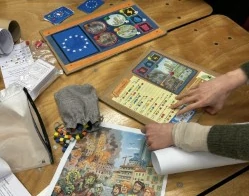
On the second day, participants were introduced to the Europe United board game and were honoured to meet a very special guest - the game developer Federico Dumas – who joined the training to explain the rationale, the challenges and the process behind its development. Europe United is a cooperative board game, designed for young people to impersonate EU member states. Their challenge is to find a compromise between their individual country’s self-interest and the common goal to be achieved in collaboration with the other playing nations. The game translates complex EU structures - such as the EU single market - into an accessible and engaging experience. To make sure the game can be repeatedly played, different scenarios were developed where players have to solve big societal challenges such as climate change, a global pandemic or migration management. Alongside EU knowledge, key skills such as cooperation, critical thinking, and democratic participation are fostered. The participants then proceeded to play the game guided by the facilitators to understand its rules and mechanics. Feedback on the game was gathered to enhance the prototype and make it even more accessible for young people. In the afternoon, an expert from Zefiro guided a video editing workshop to ensure participants’ gain communicative skills to promote the board game in their organisations and beyond.
On Friday, after collecting feedback on the Europe United game and the previous sessions, Sophie Brandes (YES Forum) gave an overview of the logistical requirement for the project and introduced the next steps following the training. Local training will start to ensure at least additional staff members are trained to facilitate board game sessions for young people starting from the next school year (September 2026); as part of the project, the best EU players from each partner organization will participate in a tournament and summer camp in Romania. The next session led by Mirco Trielli (Zefiro) shared the experiences of Zefiro with successful engagement strategies to build a local network and ensure the board game reaches different schools, youth clubs and organisations in the local community. Through different activities - such as developing an engagement manifesto or mapping the local stakeholders - participants learned how to reach their target groups. Another important skill session was led by Elie Demerseman (YES Forum) on how to train trainers and facilitators, through tricks and tips coming from his extended experience as trainer of trainers. Lastly, the afternoon sessions were devoted to presenting the EU in pills, sharing online resources for youth workers and teachers on EU education and testing the participants’ knowledge of the EU through a game quiz.